Choosing the 2026 best educational toys begins with a simple question: what are educational toys, really?
Educational toys are play materials designed to support skills such as problem-solving, language, coordination, creativity, and social development. They may include wooden puzzles, building blocks, counting games, science kits, or pretend-play sets. However, a high price does not guarantee meaningful learning. A colorful box can still offer very little once the novelty disappears.
Developmental psychologist Dr. Kathy Hirsh-Pasek describes effective play as “active, engaging, meaningful, socially interactive, iterative, and joyful.” Her words provide a useful standard for evaluating toys beyond marketing claims. A strong toy invites children to make choices, test ideas, build something, and try again after failure. Think of blocks scattered across a living-room rug, or a child explaining why a paper bridge collapsed. These moments reveal learning in action.
This guide considers age suitability, durability, accessibility, safety information, and opportunities for open-ended play. It also looks at whether parents and educators can observe real progress, rather than simply seeing a child press buttons. No toy is perfect. Some products support one narrow skill, while others become confusing without adult guidance. I may favor simple toys too strongly, and digital tools can sometimes offer valuable feedback. The better question is not whether a toy looks educational. It is whether children remain curious, involved, and willing to think.
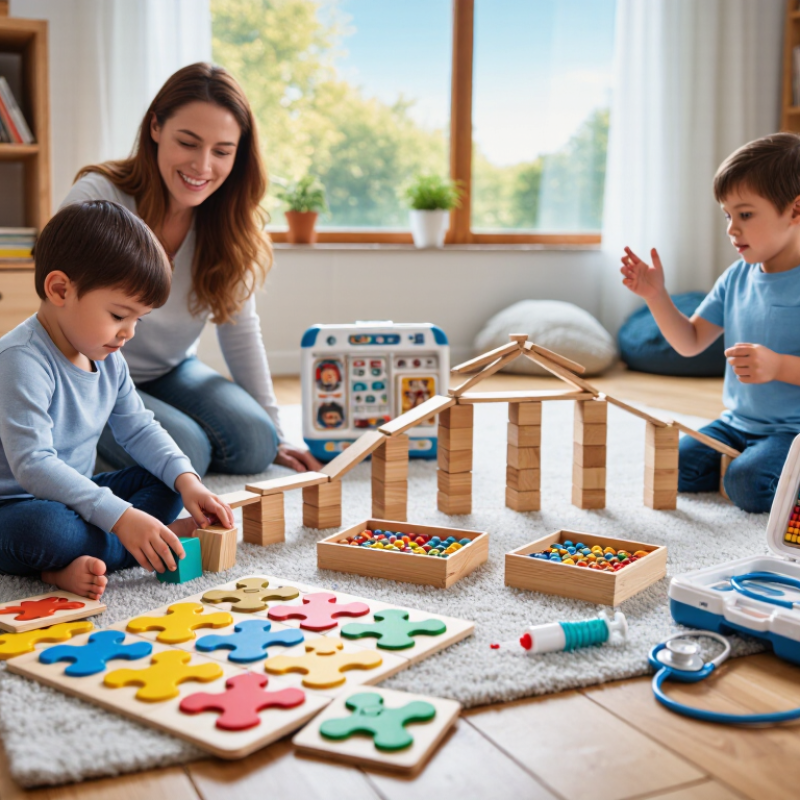
2026 Best Educational Toys: What Are Educational Toys?
Educational toys are play materials designed to build specific skills through active use. They may develop language, counting, spatial thinking, fine motor control, or social problem-solving. A wooden sorting board, for example, asks a child to match shapes, test errors, and try again. The learning happens during play, not through a printed label.
A 2023 Grand View Research report estimated the global educational toys market at about 57.3 billion US dollars. Its forecast also suggested strong growth through 2030, although market estimates differ by research method. This growth reflects demand for purposeful play, but popularity does not prove educational value. The UNICEF and LEGO Foundation Learning through Play report connects play with cognitive, physical, social, and emotional development. Still, one toy rarely supports every area equally.
In practice, the strongest educational toys usually allow more than one solution. Building pieces can become a bridge, a house, or an uneven tower. That small failure matters. It invites children to adjust, explain, and try again. Age suitability is also essential. A complex strategy game may frustrate a preschooler, while a simple matching activity may bore an older child. Adult interaction can deepen the experience through questions such as, “What could make it stronger?” Some toys promise too much. A flashing screen may hold attention without building meaningful skills. Choosing well requires observing the child, not trusting the package.
| Educational Toy Category | Typical Age Range | Core Learning Skills | Useful Design Features | Recommended Play Approach | Key Safety Considerations |
|---|---|---|---|---|---|
| Building Blocks and Construction Sets | 1–8 years | Spatial reasoning, fine-motor control, balance, planning, creativity and early mathematics | Large pieces for younger children; varied shapes, connectors and stable surfaces for older children | Begin with free building, then introduce simple challenges such as bridges, towers or pattern copying | Use oversized pieces for children under 3 years; check regularly for cracks, sharp edges and loose parts |
| Puzzles and Matching Games | 2–10 years | Visual discrimination, memory, logical reasoning, concentration and problem-solving | Clear images, graduated difficulty, sturdy pieces and a manageable number of components | Offer hints rather than completing the puzzle; increase complexity as the child gains confidence | Keep small puzzle pieces away from children who still mouth objects; store pieces in a secure container |
| Counting and Sorting Toys | 2–7 years | One-to-one correspondence, classification, sequencing, counting and early addition | Distinct colors, shapes and sizes with objects that are easy to grasp and compare | Count real objects, sort by one attribute, and later sort by two attributes or create repeating patterns | Small counters may present a choking risk; select pieces appropriate to the child’s age and ability |
| Pretend-Play and Role-Play Sets | 2–8 years | Language development, social understanding, emotional expression, cooperation and executive function | Open-ended accessories, realistic but non-stereotyped roles, and materials that support multiple scenarios | Let children direct the story; adults can model vocabulary, turn-taking and problem-solving | Avoid long cords, accessible magnets and detachable parts that are not suitable for younger children |
| Art and Craft Materials | 3–12 years | Fine-motor coordination, visual communication, sensory exploration, persistence and self-expression | Washable, non-toxic materials; tools with comfortable grips; paper and surfaces in different sizes | Focus on the process rather than a single finished product; invite children to explain their choices | Use age-appropriate scissors and supervise activities involving glue, beads, clay or other small materials |
| Science and Nature Exploration Kits | 4–12 years | Observation, questioning, measurement, classification, evidence-based reasoning and scientific vocabulary | Simple tools such as magnifiers, measuring cups, droppers and recording sheets | Ask children to predict, observe, record results and compare findings instead of giving immediate answers | Use only safe household materials when appropriate; avoid experiments involving heat, chemicals or ingestion without adult supervision |
| Early Coding and Logic Games | 4–10 years | Sequencing, pattern recognition, conditional thinking, planning and debugging | Screen-free cards, grids, directional pieces or programmable components with clear feedback | Start with short sequences, then ask children to find and correct an intentional error | Check for small parts, battery access and secure battery compartments; supervise rechargeable or electronic components |
| Musical Instruments and Rhythm Toys | 2–10 years | Auditory discrimination, rhythm, memory, coordination, communication and creative expression | Durable construction, comfortable grips, varied tones and sound levels that are appropriate for indoor use | Explore loud and soft sounds, copy simple rhythms, and encourage group music-making | Protect hearing by avoiding prolonged exposure to loud sounds; inspect for loose components and sharp edges |
| Board Games and Cooperative Games | 4–12 years | Rule-following, communication, counting, strategic thinking, emotional regulation and turn-taking | Short instructions, adjustable difficulty, visual supports and cooperative options for younger players | Choose games that match attention span; discuss decisions and feelings about winning, losing and waiting | Confirm that the rules and components suit the child’s age; supervise games containing small pieces |
| Books, Story Cards and Language Games | 0–10 years | Vocabulary, listening, phonological awareness, comprehension, sequencing and narrative skills | High-contrast images for infants, durable pages, inclusive illustrations and gradually richer text | Read interactively by asking prediction questions, naming details and inviting children to retell the story | For infants and toddlers, use tear-resistant pages and avoid loose attachments or detachable decorations |
Educational toys are play materials designed to support learning through active exploration, practice, problem-solving or creative expression. Age ranges are general developmental guides rather than strict rules. Before purchase, check the toy’s labeling, instructions and applicable local safety requirements, including rules concerning choking hazards, magnets, batteries, materials and sound levels.
They support thinking, language, movement, creativity, and social skills through active play. Learning should feel like play, not a test.
Puzzles, sorting trays, building pieces, and simple board games encourage comparison and pattern recognition. Children can test balance, shapes, and different solutions.
Counting objects, number tiles, measuring tools, and board games make numbers more concrete. Ask, “How many are left?” or “What changed?”
Picture cards, story prompts, letter pieces, puppets, and role-play materials build vocabulary and listening. A cardboard box can become a shop, house, or spaceship.
Lacing boards and clay strengthen hand control for drawing and writing. Throwing games, stacking activities, and obstacle play support balance and coordination.
Watch the child’s current interests, abilities, and reactions to difficulty. Choose manageable challenges, sturdy materials, and clear learning value. Simple is often better.
Inspect small parts, sharp edges, loose seams, and battery compartments. Avoid detachable pieces for children who still explore objects with their mouths. Supervise play.
No. Check privacy settings, offline options, screen controls, and clear age guidance. A digital toy may offer many features but little imaginative play.
Do not force the lesson. Observe what attracts the child, then adjust the activity or offer an ordinary object. I have chosen impressive toys that were ignored after one day.
This guide explains what are educational toys and why they play an important role in children’s learning. Unlike toys designed only for entertainment, educational toys encourage children to explore, solve problems, express creativity, and build practical skills through play. They can support cognitive development, language and communication, fine and gross motor skills, social interaction, emotional growth, and early STEM understanding. Different learning goals may be supported by puzzles, building materials, role-play sets, art tools, counting games, books, and activity-based toys.
The article also offers practical advice for choosing the best educational toys in 2026. Parents and educators should consider a child’s age, interests, abilities, and developmental stage rather than focusing on complexity alone. Safety, durable construction, non-toxic materials, clear instructions, and appropriate supervision are essential. When used flexibly and with encouragement, educational toys can make learning enjoyable while helping children develop confidence, curiosity, independence, and problem-solving skills.

 Bully Toy