Educational toys are often marketed as small tools with big promises. Yet parents may still ask, “how do educational toys help child development?” The answer depends on how children use them, not only on what the packaging claims. A wooden puzzle can strengthen hand control, visual matching, and persistence. Building blocks can introduce balance, planning, shapes, and early mathematics. A pretend kitchen can encourage language, cooperation, and emotional expression.
Developmental psychologist Dr. Kathy Hirsh-Pasek offers a useful reminder: “Play is not a luxury. Play is a necessity.” Her research emphasizes playful learning, active engagement, and meaningful interaction. These principles help explain why educational toys work best when children explore, make choices, and receive gentle support from adults. A parent asking, “What could we try next?” may create more learning than a toy with dozens of buttons.
The benefits are not automatic. A costly toy cannot replace conversation, movement, sleep, or responsive caregiving. Some toys may even overwhelm children with lights and sounds. Quiet play matters. So does repetition. A child may stack the same blocks every afternoon, then suddenly build a bridge for two toy animals. That small change can reveal growing problem-solving skills. Still, development is rarely perfectly neat. Children learn at different speeds, and one toy cannot measure intelligence. This guide examines seven practical ways educational toys can support cognitive, physical, social, emotional, and language development. It also considers limits, adult involvement, and safer choices for different ages.
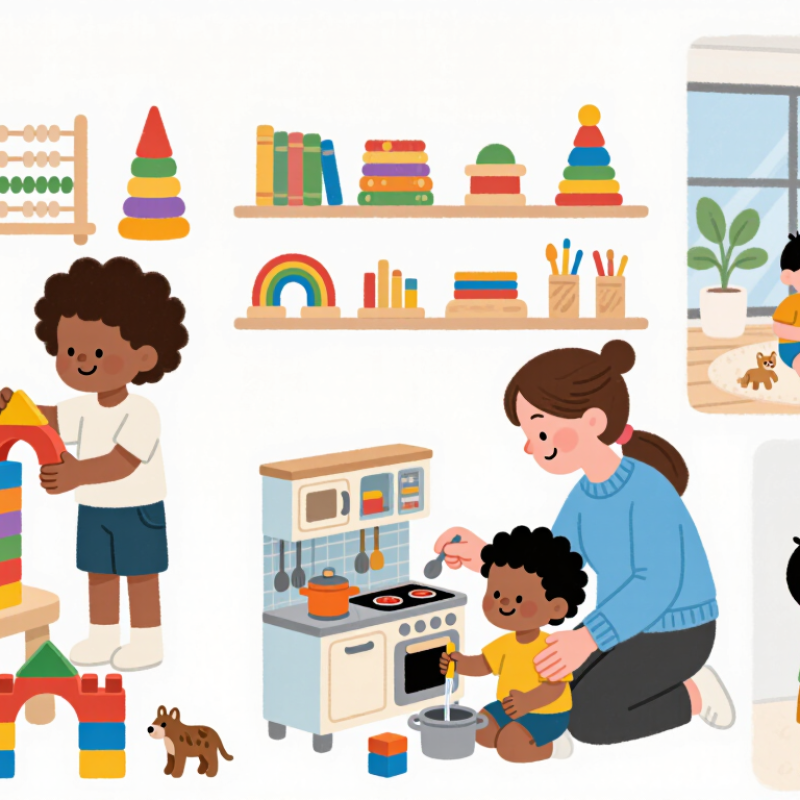
Educational toys are objects designed to make learning active, visible, and enjoyable. They may include puzzles, building pieces, sorting games, picture cards, or simple science kits. Their value comes from the learning process, not the label on the box. A puzzle can strengthen spatial reasoning. Sorting objects can introduce early mathematics. Pretend play develops language, empathy, and flexible thinking.
Play is the engine. Not every toy helps. A toy that is too difficult may create frustration, while a noisy toy can reduce concentration. Effective toys usually offer a small challenge with several possible solutions. Adults can support learning by asking, “What might happen next?” rather than giving immediate answers. This interaction encourages communication, problem-solving, creativity, fine-motor control, and self-regulation. These benefits are strongest when children choose, repeat, and modify their play.
The evidence also supports play-based learning beyond the home. UNICEF’s 2019 A World Ready to Learn report estimated that 175 million children lacked access to pre-primary education, highlighting the need for accessible learning opportunities. WHO’s 2019 guidelines recommend limiting sedentary screen time for young children, making hands-on toys a practical alternative. Still, educational toys are not magic. Their impact depends on age, safety, cultural fit, and adult involvement. A carefully chosen wooden puzzle may teach more than an expensive electronic product. Sometimes, less is better.
Developmental support areas commonly addressed through hands-on, play-based learning
Educational toys support learning by giving children opportunities to explore, repeat actions, solve problems, communicate, and create. The 1–5 scale is an illustrative comparison of how strongly each developmental area is typically engaged during purposeful play; it is not a clinical assessment.
Educational toys can turn ordinary play into a small thinking laboratory.
A child fitting wooden shapes into a board compares size, direction, and position. Each failed attempt gives useful feedback. The child learns that problems can have several solutions.
Puzzles strengthen memory, attention, and visual reasoning. Building sets encourage planning before action. Counting games connect symbols with real quantities, such as three buttons or five blocks. Open-ended toys also support creativity because children must decide what to build.
I have noticed that children often explain their ideas while playing, which develops language and logical sequencing. Their explanations may sound incomplete. That is normal. Adults should ask, “What could you try next?” instead of solving the problem too quickly.
Educational toys work best when the challenge is manageable but not effortless.
A task that is too easy may create boredom. A task that is too difficult may cause withdrawal. Research-informed practice suggests matching toys with a child’s age, interests, and current abilities. However, age labels are only general guides. Two children of the same age may need different levels of support.
Short play sessions can be effective. Watch how the child tests ideas, changes strategies, and responds to mistakes. Some toys may promise learning benefits, yet the child may simply ignore them. That response matters. Real development comes from active thinking, conversation, and repeated problem-solving, not from the toy alone.
Play-based toys give children natural reasons to speak, listen, and respond. A toy kitchen can inspire words like “hot,” “pour,” and “more.” Building blocks encourage children to describe size, color, position, and action. During guided play, adults can model clear language without controlling every move. Research on early childhood learning supports this responsive approach. Children learn more when conversation follows their interests.
Pretend play also strengthens social communication. One child may become a shopkeeper, while another asks for an item. They practice taking turns, explaining ideas, and solving small disagreements. Picture cards, story figures, and sound games can support vocabulary and memory. Still, no toy guarantees progress. Some children may avoid speaking at first, and that response deserves patience. Adults should watch carefully and adjust the activity. A mistake is not always a problem. It can reveal what the child needs next.
Tips: Choose toys with several possible uses. Ask open questions, such as “What happens now?” Wait before answering. Add one new word to the child’s sentence. For example, respond to “car fast” with “Yes, the red car is fast.” Keep screens and noise limited during shared play. Short, regular play sessions often work better than forced practice.
Educational toys can turn ordinary play into practice for social, emotional, and motor growth.
A cooperative puzzle asks children to share pieces, wait, and explain ideas. These small exchanges build language and self-control.
When a child loses a game, an adult can name the feeling instead of fixing it immediately.
That response supports emotional awareness, though patience sometimes runs thin.
Building blocks strengthen grasp, wrist control, and hand-eye coordination. Threading beads and using child-safe tools refine finger movements needed for drawing, dressing, and eating.
Large movement toys invite pushing, balancing, and reaching. Pediatric occupational therapists often use play-based tasks because one toy can offer different levels of challenge.
A three-year-old may stack six blocks, while an older child designs a bridge.
The result is not always neat. That is part of learning.
Pretend-play sets can help children negotiate roles, notice another person’s perspective, and repair disagreements.
An adult might ask, “How can both characters get a turn?” rather than giving the answer.
This keeps the child thinking.
Choose toys that match current abilities, with safe materials and close supervision. Avoid turning every activity into a lesson.
Children also need quiet, messy, self-directed play.
A carefully selected toy can support development, but it cannot replace responsive adults, conversation, movement, or real friendships. I may expect too much from a clever toy; watching the child matters more.
Choosing educational toys starts with a child’s developmental stage, not a colorful package. For infants, select soft, washable objects with contrasting textures and gentle sounds. They encourage sensory attention, grasping, and early interaction. For toddlers, use large puzzles, stacking cups, and push-pull toys that demonstrate simple cause and effect. Avoid tiny parts. The CDC’s milestone guidance connects play with developing movement, language, and social skills from infancy through age five. The American Academy of Pediatrics’ 2018 clinical report recommends toys that encourage shared play, imagination, and problem-solving. A practical test is simple: Can a caregiver join without taking over?
Between ages three and five, pretend kitchens, puppets, art materials, and matching games can strengthen language, self-regulation, and fine motor control. For early school years, choose open-ended construction, measuring, reading, and cooperative strategy games. These activities invite planning, spatial reasoning, and negotiation. The Lancet estimated that 250 million children in low- and middle-income countries risked missing their developmental potential because of poverty and stunting. Responsive play cannot solve structural inequality, but it can enrich daily interaction. The 2020 Common Sense Census reported 2 hours and 24 minutes of daily screen media among U.S. children aged zero to eight. Hands-on choices still matter. I have sometimes overvalued “educational” labels. Children may learn more from a plain box, patient questions, and repeated attempts. Check safety, durability, cultural fit, and challenge level. A toy that is too easy becomes decoration; one that is too difficult becomes frustration.
They give children small problems to test. A shape may fit, fail, and fit again. Each attempt provides useful feedback.
Puzzles, matching cards, and shape boards can strengthen memory and attention. Children compare position, direction, size, and pattern.
Ask, “What could you try next?” Wait before helping. Let the child change strategies. Quick adult solutions can interrupt learning.
Blocks and loose parts can become bridges, houses, or something unexpected. The child chooses the goal. The result may look unfinished.
A toy kitchen creates words like “pour,” “hot,” and “more.” Blocks encourage children to describe color, size, movement, and position.
Stay patient and follow the child’s interest. Model one clear phrase. Do not force a response. Quiet observation may show the next need.
Cooperative puzzles teach sharing, turn-taking, and explaining ideas. Pretend play helps children negotiate roles and notice another person’s feelings.
Threading beads strengthens finger control. Blocks develop grasp and hand-eye coordination. Pushing, balancing, and reaching support larger movements.
Match the toy with the child’s interests and current abilities. Age labels are only rough guides. A manageable challenge works best.
No toy works alone. Active thinking, conversation, movement, and real friendships matter more. Sometimes the child simply ignores the toy. That response matters.
Educational toys are designed to make learning engaging through play, helping children explore ideas, practice skills, and build confidence. They can support early learning by encouraging curiosity, attention, memory, counting, matching, creativity, and problem-solving. Instead of simply providing entertainment, these toys invite children to make choices, test solutions, and learn from mistakes. This explains how do educational toys help child development: they turn everyday play into meaningful opportunities for mental growth.
Play-based toys also strengthen language and communication as children name objects, follow instructions, create stories, and interact with others. Cooperative activities can develop sharing, patience, emotional expression, and teamwork, while hands-on toys improve fine motor control, coordination, and physical awareness. The best choices should match a child’s age, interests, abilities, and stage of development. Simple toys may suit younger children, while older children can benefit from more challenging activities that encourage planning, creativity, and independent thinking.

Bully Toy